
As printed in STORIED Magazine Volume 3: The Cedar Issue.
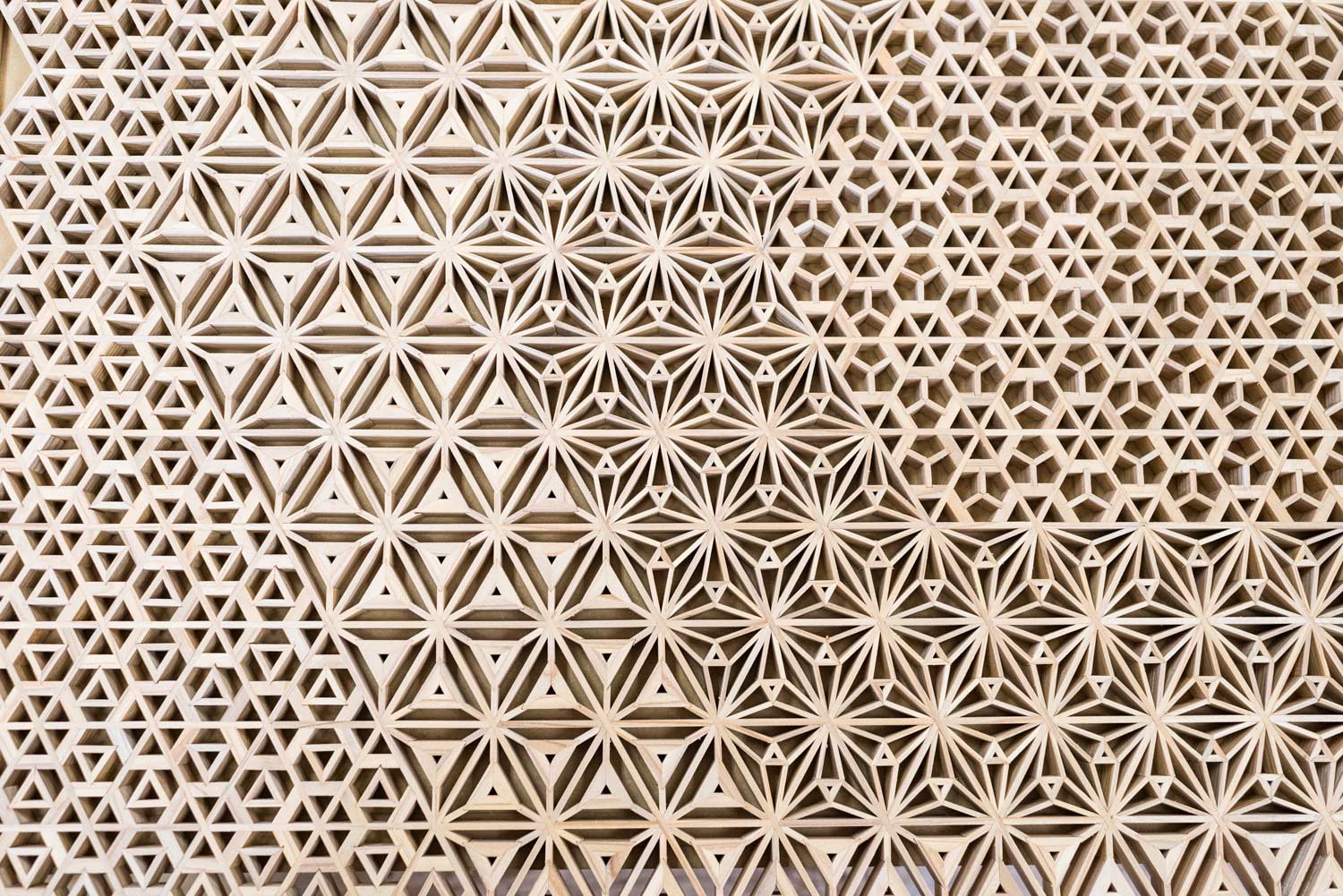
Walking through the narrow streets of Tokyo’s Edogawa ward, under the cover of an umbrella in the middle of spring, I notice a transition from skyscrapers to a patchwork of modern, low-rise buildings with a family neighborhood feel. There’s a nursery school, a few soba restaurants, a Japanese confectionery shop, and small-scale apartment complexes. It is calm and quiet here. Gentle falling rain accentuates a scent of fresh cedar and my nose senses my destination before even my eyes. I’m here to observe the inner workings of Edo Kumiko Tatematsu, a father-son duo specialising in the art of kumiko, a traditional Japanese woodworking technique that combines small, thin pieces of wood, without the use of nails, to create various patterns used in the creation of furniture and furnishings.
Matsuo Tanaka, the father, was born into a family of carpenters. He started out making wooden fittings, such as screen doors and shutters, whilst apprenticing at a joinery shop when he was 15 years old. The master under whom he learned his craft made kumiko as well, but he closely guarded the production techniques for fear that this lucrative craft would become less so for him with more competition. After almost ten years working under the craftsman, Matsuo began to teach himself kumiko by watching his master’s methods and by studying the craft through books. When he was 39 years old he founded his company, Tatematsu, a combination of the word tateguya (joinery shop) and his given name, Matsuo.
As kumiko work is often put into a building’s construction towards the end of its completion, orders are given to craftspeople only one to two months in advance. This means that more and more kumiko manufacturers are using machines to finish the work quickly. However, Edo Kumiko Tatematsu still prefers to create everything by hand. They have too noticed a shift in their client’s preferences – less demand for traditional Japanese room fixtures in contemporary housing styles – so the Tanaka family is looking for new ways of taking the traditional craft and adapting it to modern architecture and products. The commitment of Tatematsu, crafting kumiko the traditional way, fueled my excitement to learn and capture the process in person.
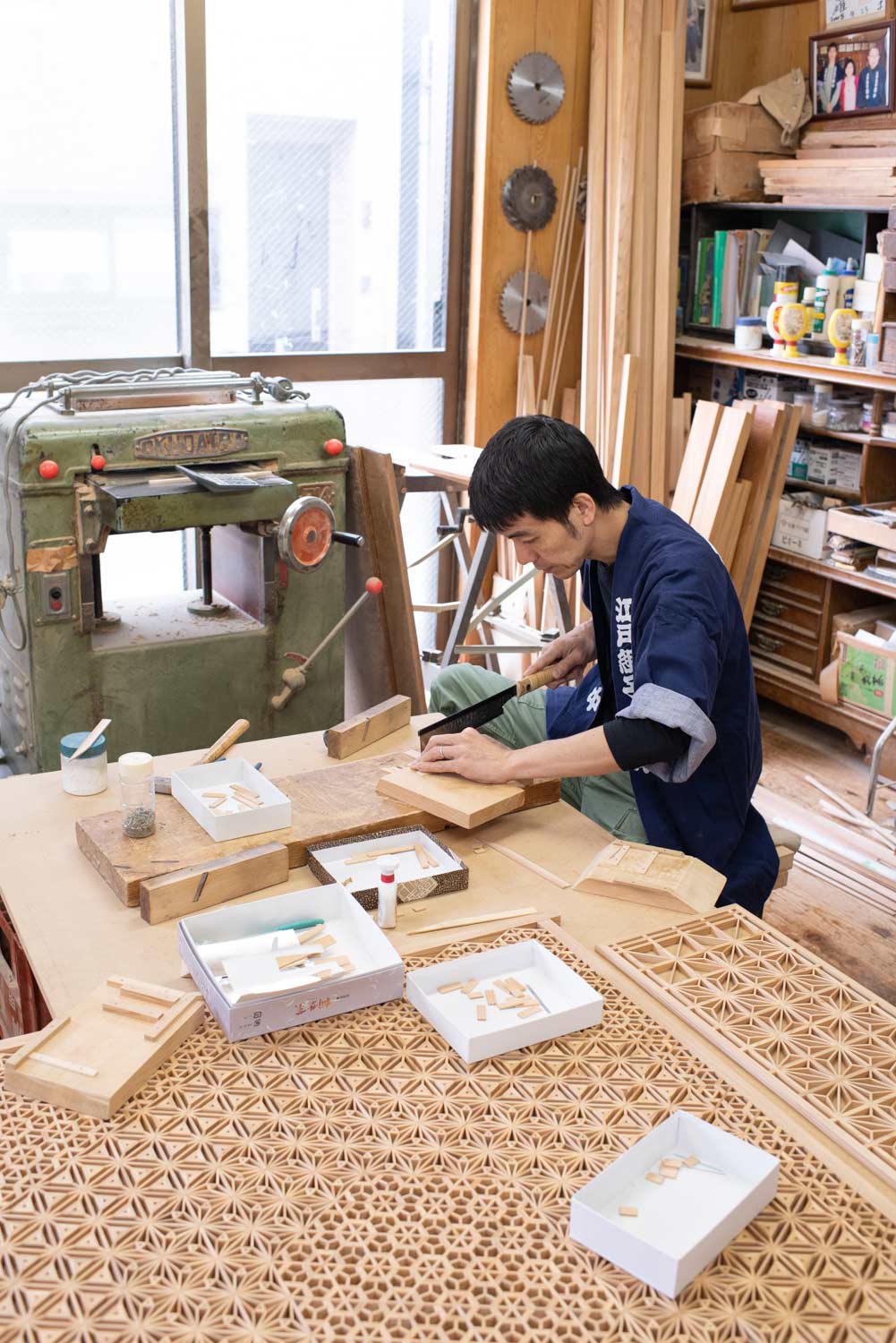
My visit begins by meeting Takahiro Tanaka, the son who started out as an architect before joining his father in the family business. He would later tell me that, as a child, he always loved to make things, coupled with the similarity his father’s occupation had to architecture, he decided to initially pursue this as a career path, knowing that it would help him when eventually succeeding his father at Tatematsu.
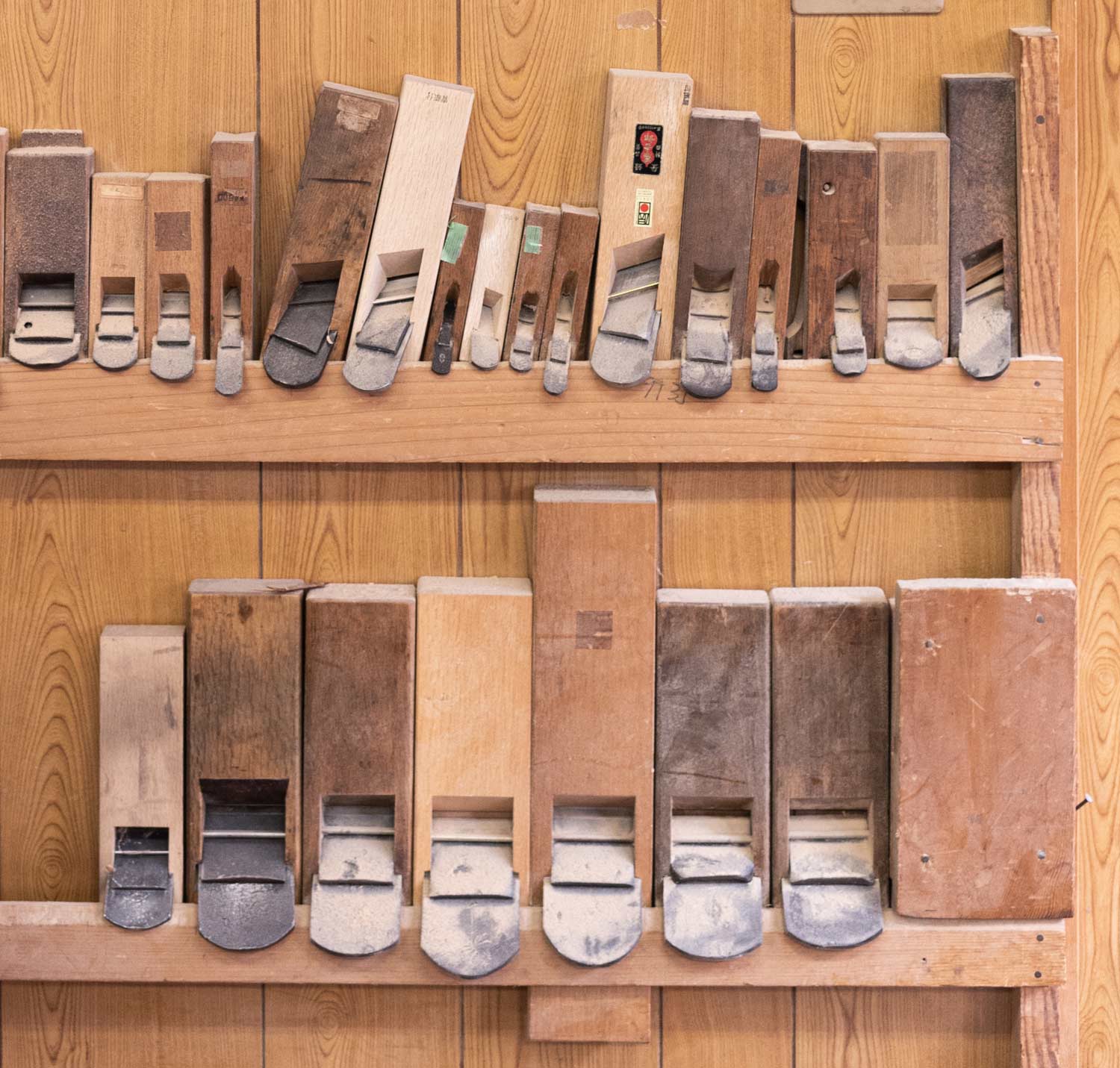
As I enter the workshop I am greeted by the sight of floor-to-ceiling wood-panelled walls that are covered with a variety of tools. Saw blades are mounted on nails and hand planes are vertically placed side by side on a shelf near the door. The earthy aroma of cedar is both rejuvenating yet brings with it a sense of calm and clarity. Takahiro introduces himself with a smile, which shines even brighter against his indigo-dyed craftsman’s jacket that features the company name in white. He shows me around the studio and stops in front of a small kumiko screen depicting the four seasons with interwoven patterns of sakura (cherry blossoms), futaeasa (double hemp leaves), kikyo (bellflowers), and yuki-no-kesshou (snow crystals).
There are hundreds of possible kumiko designs to create, most of which are inspired by nature. I notice an almost blue-grey hue and a fine grain – it is an unusual type of wood. I look a little closer, ‘this is Jindaisugi [a type of tree] that was buried under volcanic ash for anywhere between 400 to 1000 years, so naturally, it has been deeply coloured’, Takahiro tells me, satiating my look of inquisition. At Tatemasu the craftsmen use some cypress, but the majority of the wood used for kumiko is cedar, which is extremely hard. This is important as softer wood tends to warp and shrink a little when putting the pieces together, making it more difficult to achieve a sharp pattern. I ask him about the ideal wood for kumiko: ‘Cedar from a cold region, like Akita prefecture, is the best because it has a narrower grain’, he explains, running his fingers over distinct lines on the surface of a nearby board. Takahiro tells me that they also use Yoshino cedar from Nara, and yakusugi, a type of slow growing cedar that can reach over 1000 years of age. Yakusugi is found on Yakushima, a remote, subtropical island off the coast of Kyushu, known for its ancient virgin forests.
He sees me marvelling over a lamp with an asanoha (hemp leaf) design and proceeds to turn off the workshop lights, creating a darkness in which I can appreciate the full beauty of light and shadow elicited through the patterned latticework. The cedar glows warmly from the light of the bulb. The asanoha shape is a popular one – considered as a talisman to prevent unfortunate events – it is also Takahiro’s favourite design to make. The process is intricate, taking approximately four days to carve the pieces to produce one of the smaller lamps, and up to one month to craft something like a shoji (screened windows or doors made of paper).
Tatematsu creates fittings and fixtures such as byobu (folding screens), majikiri (room dividers), and ranma, a screen found above a sliding door used for ventilation in traditional Japanese wooden houses. The applications for kumiko extend well beyond these, and Takahiro uses his background as an architect to influence the type of kumiko products they now offer, which include contemporary pieces and custom projects for their clients. ‘Because I have studied architecture and can create architectural drawings, I think that I can present an image of a finished product to the customer and propose a design that is in harmony with their room.’
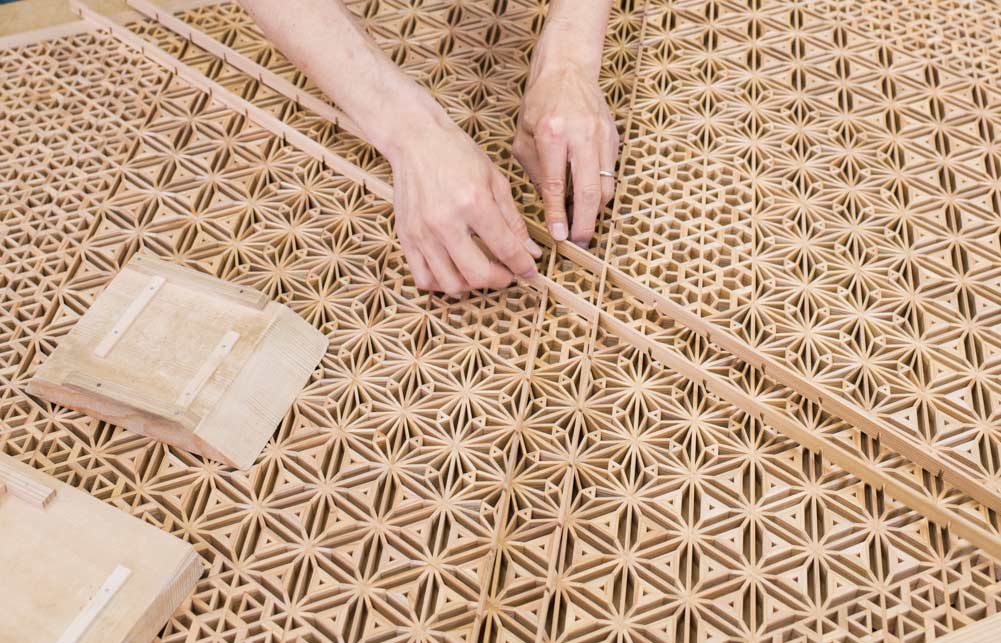
I’m directed to a low work table in the centre of the room to see the kumiko process in more detail. On the table sits a large rectangle window screen roughly 120cm by 90cm in size, complete with an intricate design featuring hexagonal bands of floral kumiko patterns, similar to those on the screen I saw earlier. To show me how the initial framing for the wood is set up, Takahiro places four long, thin wooden slats over the finished work. He then crosses the four strips into an X shape, mirroring the frame underneath so I can see how the lines form a diamond shape. From there, it’s all about filling in the ‘diamonds’ with wooden pieces cut into the correct angle in order to elucidate the desired pattern. I’m told that the most difficult part is cutting the wood accurately – within one-tenth of a millimetre – so that it will fit perfectly into place. No easy feat, when you consider that the approximately 30cm tall asanoha lamp he had just finished consists of about 2500 constituent pieces.
I watch closely as Takahiro demonstrates the different parts of the kumiko process. Starting with one of the many hand planes resting on the shelf behind us, he slides it across a strip of wood with the utmost control. Here, precision is key. I hear a crisp, soothing sound as the shavings curl into impossibly thin ribbons whilst the strips are worked into just the right thickness. From here they are cut with a fine tooth hand saw into smaller pieces that are ready to be used in construction. Depending on the final design of the pattern, the ends of each wooden piece need to be chiselled into a specific angle in order to fit the framework. I hover over the table, fascinated as Takahiro shows me the finishing step: he places one of the angled wooden chips that has just been manipulated into a small lattice frame containing the makings of an asanoha design. With a practised hand, he gently nudges it into place so that it rests perfectly snug against other pieces of wood that have already been laid, completing the pattern. It reminds me of an intricate puzzle, though one with no room for error.
I look up to see Matsuo Tanaka arriving in his traditional Edo Kumiko Tatematsu jacket. We greet each other and I acknowledge his dedication to the craft of kumiko. I am impressed to find out that he was honoured as an ‘intangible cultural asset’ of the Edogawa Ward in 2006 for his mastery of kumiko. Takahiro gestures towards his father’s hands, and Matsuo lifts them for me to see. They’re permanently bent as if his fingers were still curled over a wood planer – a result of crafting kumiko for 60 years. These days, Matsuo only occasionally works on pieces, stepping aside to let Takahiro continue the Tatematsu legacy.